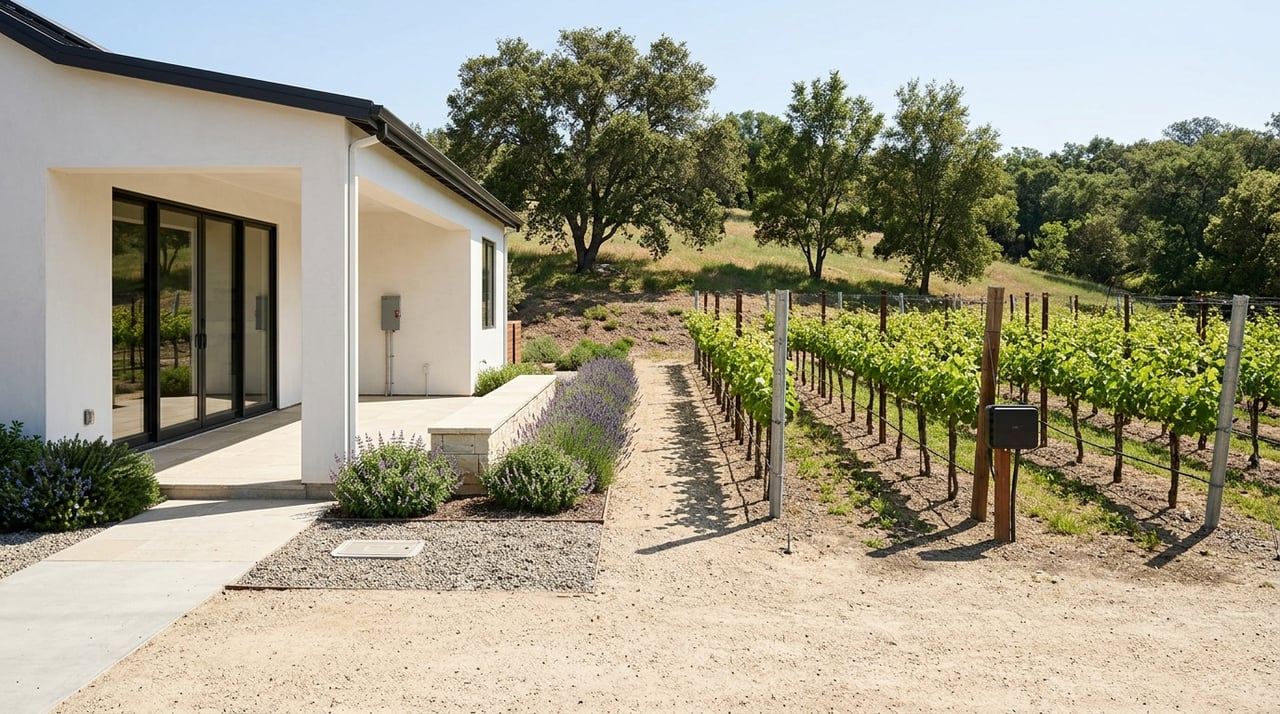
If you are shopping for vineyard land or rural acreage in Carmel Valley, it is easy to fall for the view first. But in this market, the most attractive parcel is not always the most usable one. If you want to make a smart decision, you need to look past the scenery and evaluate the land through the lens of planning rules, water, soils, access, and long-term practicality. Let’s dive in.
Start with county land-use rules
In Carmel Valley, parcel evaluation should begin with Monterey County’s planning framework, not just the number of acres on the listing. The Carmel Valley Master Plan and Carmel Valley Village Development Criteria still guide how land is used in the area, with a strong focus on preserving rural character, scenic resources, watersheds, and agricultural land.
That matters because the land-use designation can shape what you may realistically do with a property. In some residential areas, the overall density is capped at one unit per 2.5 acres. The Master Plan also supports a low-density, clustered approach in certain areas rather than broad, spread-out development.
If you are comparing two parcels with similar size, one may offer a much clearer path for your goals than the other. A good first step is to confirm the parcel’s designation and whether any planning limits could affect future building, planting, or site changes.
Check for agricultural preserve status
Some rural properties in or near Carmel Valley may be part of Monterey County agricultural preserve programs, including Agricultural Preserves and Farmland Security Zones. These are voluntary programs, but they can affect how land is used and preserved over time.
If a parcel is under this kind of contract, you will want to understand how that aligns with your plans. For buyers who value land stewardship and agricultural continuity, this may be a plus. For buyers hoping for broader non-agricultural use, it may require a closer review.
Understand AVA status if wine production matters
Carmel Valley is a federally recognized American Viticultural Area, or AVA. If your long-term goal includes marketing wine under the Carmel Valley AVA name, labeling rules apply.
Under those rules, the labeled grape-growing area must be the Carmel Valley AVA, and at least 85% of the wine must come from grapes grown there. Finishing also must occur in California or another state in which the AVA lies. If branding and wine identity are part of your vision, this detail deserves attention early.
Evaluate the land itself
In vineyard and acreage purchases, the ground matters more than the view. A dramatic hillside may look impressive, but if slope, drainage, or soil conditions work against you, the parcel can become more expensive and less flexible than expected.
UC viticulture guidance points to well-drained soils as a key requirement for grapes. Poor drainage should be avoided, and raised beds may help where there is hardpan, claypan, or shallow bedrock. Steeper sites can also create more erosion risk and make equipment use and day-to-day work harder.
In Carmel Valley, this is very much a parcel-by-parcel question. The original AVA petition described a sunny interior valley climate with about 2,317 degree-days and roughly 16.5 to 22.5 inches of annual precipitation, and it identified several steep-slope soil phases viewed as suitable for viticulture. That does not mean every hillside works equally well, but it does show why careful site review matters.
Pay attention to slope and aspect
Aspect can influence how a site performs through the season. East-facing slopes tend to dry sooner after dew or rain, while south- and west-facing areas are generally warmer.
In a warm-climate setting like Carmel Valley, you should ask where the parcel gets morning sun, where cold air may settle, and whether row orientation could help reduce heat stress or erosion. These are practical questions that can affect both planting success and ongoing maintenance.
Use soil data as a first pass
A helpful first screen is to review soil series and slope constraints through the USDA NRCS Web Soil Survey. This can help you spot potential red flags before you invest more time and money in deeper due diligence.
That said, map data is just a starting point. It is wise to confirm findings with a local soil professional or vineyard consultant who understands how Carmel Valley parcels behave on the ground.
Water and septic often decide the deal
For many rural properties, water and wastewater are the true gatekeepers. A parcel can have beautiful terrain and strong vineyard appeal, but if the well is weak or the septic situation is limited, the property may not fit your intended use.
Monterey County’s Environmental Health Bureau regulates onsite wastewater treatment systems and well construction in the county. That means septic capacity is not a side issue. It is central to whether a rural homesite or vineyard property works.
The county states that a conventional septic tank or leach field must be at least 100 feet from a water well. Engineered systems are often needed when a site has high groundwater, poor soils, bedrock near the surface, limited undisturbed area, or slopes greater than 30%.
Ask better well questions
A rural property tour should include more than a quick look at the pump house. You should ask about the well’s age, yield history, water quality testing, pump history, storage capacity, and whether the well is properly permitted.
If the parcel is within the Monterey Peninsula Water Management District boundary, there may be added requirements. The district requires well registration, annual production reporting, and water meters for new wells. It also uses water permits when a project intensifies water use.
For buyers considering a home, guesthouse, irrigation plan, or similar expansion, those details matter. You want to know not only whether water exists today, but also whether future use could trigger more review.
Remember that young vines need water
Water demand is not limited to household use. UC guidance notes that new vineyards need water to establish young vines and often need water for spring frost protection and summer irrigation.
That means a limited well can be a non-starter, even when the parcel checks other boxes. If vineyard use is part of your plan, reliable production matters just as much as location and soils.
Think about access, fire safety, and buildable area
One of the biggest surprises for buyers is how much of a parcel may be less usable than it first appears. Access constraints, defensible space, emergency vehicle needs, and visual protection policies can all reduce where you can comfortably build, plant, or improve the site.
Monterey County identifies Carmel Valley, Carmel Valley Village, and Cachagua as high-risk wildfire areas. Fire behavior in these settings depends heavily on fuel, slope, and weather, which makes site layout especially important on larger rural parcels.
CAL FIRE requires 100 feet of defensible space around structures. On acreage, that can reduce the amount of land available for landscaping, vineyard rows, or other uses once clearances are accounted for.
Review driveway and emergency access early
The Carmel Valley Village Development Criteria call for site planning that respects topography, drainage, solar access, and emergency access. The Carmel Valley Master Plan also emphasizes preserving view corridors, minimizing grading, and discouraging too many driveways along Carmel Valley Road.
In practical terms, you should look closely at driveway grade, turnaround space, gate placement, and whether emergency vehicles can reach the site without major earthmoving. A parcel that seems straightforward on paper may become much more complex once access requirements are mapped out.
Protect drainage and sensitive areas
UC guidance also recommends phased development, erosion control, drainage planning, limiting hardwood removal, and checking riparian setbacks before clearing land for vines or roads. If a property includes creek corridors, erosion-sensitive areas, or established oaks, those features should be part of your evaluation from the start.
This is not just about regulation. It is also about preserving the land’s long-term function and character, which is a major part of what makes Carmel Valley acreage appealing in the first place.
A simple Carmel Valley tour checklist
When you walk a parcel, try to evaluate it as both a property and a system. The goal is to understand how the land, infrastructure, and local rules work together.
Here are a few smart questions to bring with you:
- What is the parcel’s land-use designation?
- Is it inside the Carmel Valley AVA, an agricultural preserve, or the Monterey Peninsula Water Management District boundary?
- Where are the usable benches, steepest slopes, frost pockets, and first morning sun?
- Has the septic system been inspected recently?
- Is there enough room for the home, any accessory structure, and the intended wastewater field?
- Is the well permitted and, where required, metered?
- Does the well have enough reliable production for domestic use and irrigation?
- Are there oaks, creek corridors, or erosion-sensitive areas that should remain undisturbed?
- Does legal access exist all the way to the building site?
- Can the road or driveway support fire-service access and long-term maintenance?
What matters most in Carmel Valley
In the end, the best acreage parcel is usually not the one with the highest acre count. It is the one with the strongest combination of legal access, verified water, septic feasibility, workable slope, good drainage, useful sun exposure, and wildfire resilience.
That is especially true in Carmel Valley, where planning policies, natural conditions, and rural infrastructure all shape what is realistically possible. When you evaluate land with those factors in mind, you can move from a scenic first impression to a more confident decision.
If you are considering vineyard land or rural acreage in Carmel Valley, Carmel Valley Realty Company can help you evaluate the property through a local, practical lens and guide you toward a more informed purchase.
FAQs
What should you check first on a Carmel Valley acreage parcel?
- Start with the parcel’s land-use designation under Monterey County planning rules, because acreage alone does not tell you what the property may support.
How important is water for a Carmel Valley vineyard property?
- Water is often a deciding factor because vineyards need reliable supply for young vine establishment and, in many cases, for frost protection and summer irrigation.
Do septic rules affect rural land in Carmel Valley?
- Yes. Monterey County regulates onsite wastewater systems, and septic feasibility can limit where and how a property can be improved.
Does being in the Carmel Valley AVA matter to a buyer?
- It matters if you want to market wine under the Carmel Valley AVA name, because labeling rules require the grapes and production to meet specific standards.
Why does slope matter on Carmel Valley vineyard land?
- Slope affects erosion risk, equipment access, safety, and in some cases septic feasibility, so it can strongly influence usability and cost.
How does wildfire risk affect buildable acreage in Carmel Valley?
- Defensible space requirements and emergency access needs can reduce the area available for structures, landscaping, or planting on rural parcels.